

Home › Articles › Cosmetic Dentistry Cosmetic Dentistry Teeth whitening: which methods really work and how long the results last Dr Christos Vasilaras Dentist · 10 min read · August 2026 Teeth whitening is one of the most requested cosmetic treatments today, and at the same time one of the most misunderstood. Quite a few …


Cosmetic Dentistry

Teeth whitening: which methods really work and how long the results last

Teeth whitening is one of the most requested cosmetic treatments today, and at the same time one of the most misunderstood. Quite a few misconceptions have built up around it, from products that promise whitening without actually changing the color of the tooth, to the fear that it wears down the enamel.
So it’s worth taking a purely scientific look at what is actually true: how teeth are whitened, which methods work and how long the results last.
In this guide we explain how teeth are whitened, which methods deliver results, which ones just clean the surface, and how long whitening lasts. Also whether it damages the enamel and who it isn’t suitable for. Our goal isn’t a promise of “snow-white” teeth, but a natural, brighter smile that we achieve safely.
The short answer
Real results come from professional whitening, either in the office or at home with custom trays made by the dentist. Over-the-counter products mainly remove surface stains and don’t change the color of the tooth. The result usually lasts 8 to 12 months, and in many patients even longer, depending on their habits.
Why teeth turn yellow and darken
Before we talk about whitening, it’s worth understanding why teeth change color, since the cause of the discoloration also determines the most suitable treatment. Stains fall into two main categories.
Extrinsic stains. These are caused by substances that come into contact with the teeth every day, such as coffee, tea, red wine, foods with strong pigments and, above all, smoking. They usually respond very well to cleaning and whitening.
Intrinsic stains. These come from inside the tooth. They can appear with age, as the enamel thins and the naturally more yellow dentin becomes more visible, after an injury or a root canal treatment, as well as because of certain medications taken in childhood. These discolorations are more challenging and often need a different or combined approach.
That’s why, before any whitening method is chosen, it is important to identify the real cause of the color change.
How teeth are really whitened
Whitening isn’t cleaning. The active ingredient of the whitening agent is hydrogen peroxide or carbamide peroxide. The agent penetrates the enamel and dentin and chemically breaks down the molecules that give the tooth its dark or yellow tone. That’s why a whitening toothpaste, which acts only on the surface, can’t deliver the same result as a whitening gel.
A clarification is worth making here, since it confuses many people. The lamp you see in some protocols, LED or “laser,” doesn’t whiten on its own. It simply speeds up the action of the gel. It’s the peroxide that changes the color, not the light.
The methods, and what to expect from each
- In-office whitening. High concentration, visible results in one to three sessions.
- At-home trays from the dentist. Professional gel, daily use for 10 to 20 days.
- Drugstore toothpastes and strips. Surface stains, limited change in shade.
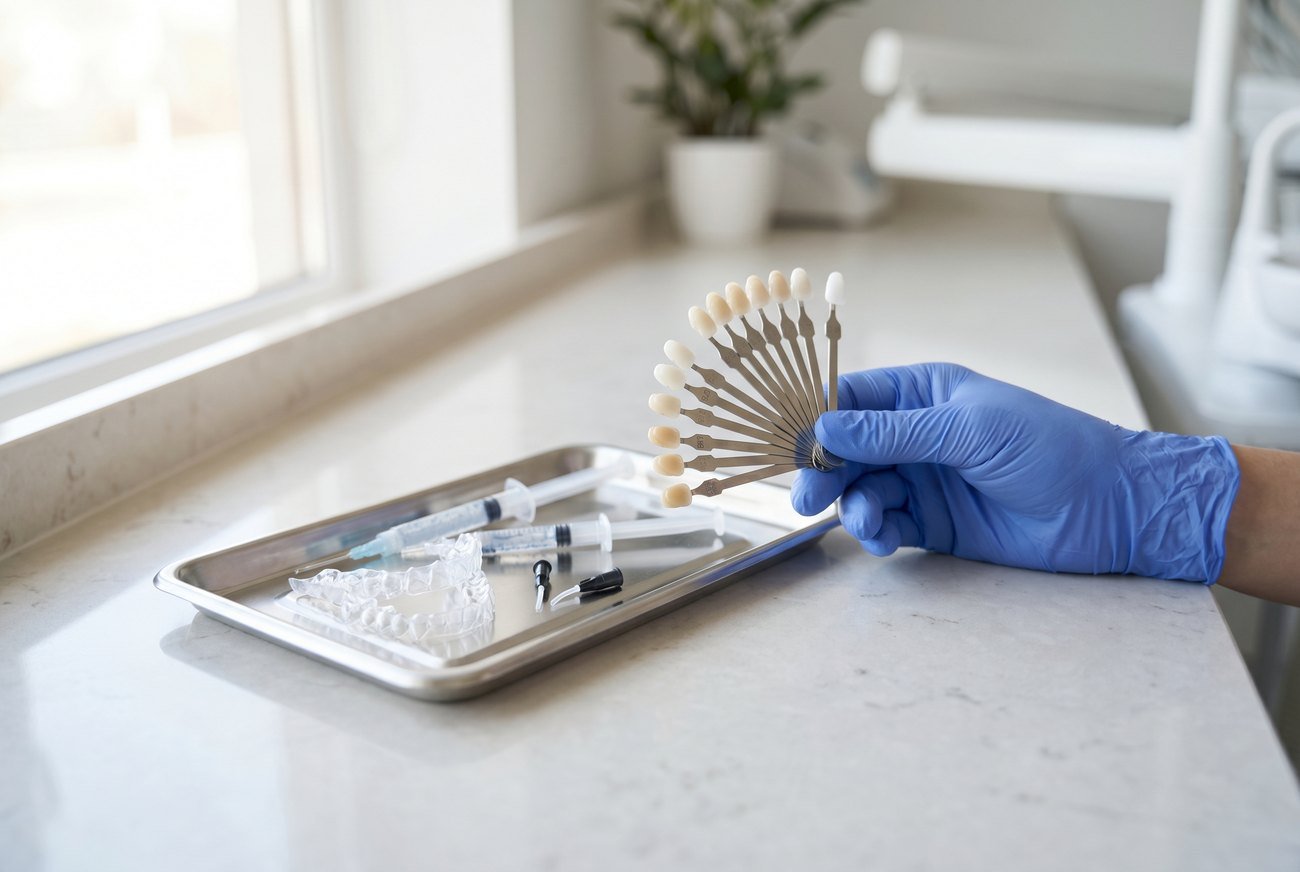
With in-office whitening, the dentist protects the gums while applying the whitening gel and achieves an immediately visible result in a single visit. With tray whitening, the process is different. We take an impression and make custom trays that fit your own teeth exactly. You are given whitening material, which you place in the tray so that it acts evenly. We often combine the two: one session in the office for a quick start and trays for maintenance at home.
There is also a practical reason to choose the dentist, beyond the result. European legislation allows strong whitening products, with a peroxide concentration from 0.1% up to 6%, only inside the dental office. Whatever is sold freely outside it has a much lower concentration, and therefore a poorer result.
What won’t whiten, whatever you do
Whitening works only on the natural tooth. Artificial materials keep the color they were made in, so they don’t change shade:
- fillings
- porcelain veneers
- crowns and bridges
This has a practical consequence for the order of things. If you’re considering whitening and you have, or will get, esthetic restorations on your front teeth, we whiten the natural teeth first and then match the restorations to the new, brighter shade. Otherwise, the artificial tooth will look darker next to the rest.
A separate case is a single tooth that has changed color after a root canal treatment. These cases aren’t treated the usual way; they need internal whitening. The same applies to deep discolorations, such as those caused by an old antibiotic (tetracycline).
How long whitening results last
Whitening results aren’t permanent, since the teeth come into contact with pigments every day. In most people they last 8 to 12 months, while in those who watch their habits they can last even several years.
How long they last depends mainly on daily habits:
- Smoking is the biggest factor in restaining.
- Coffee, tea and red wine speed up the restaining of the teeth.
- Regular cleanings and good oral hygiene help maintain the result.
The result can easily be refreshed with a quick touch-up, usually every 12 to 18 months. That way, the brightness of your smile is maintained without needing a complete whitening treatment from scratch each time.
How to make the results last longer
The first forty-eight hours after whitening are the most critical, as the tooth is temporarily more receptive to pigments. During this time it helps to keep to a more color-neutral diet and avoid anything that stains, namely coffee, tea, red wine, colored soft drinks and smoking. After that, a few small habits protect the result. Drink staining beverages through a straw when possible, rinse your mouth with water after them, and keep up consistent brushing and regular cleanings. That way, whitening isn’t something you do once and forget, but a result you maintain with minimal effort.
Does whitening damage teeth
It’s the most common fear, and the answer is no, when it’s done properly. Professional whitening at the right concentration and under dental supervision doesn’t destroy the enamel. The most common thing you’ll feel is temporary sensitivity to cold or mild gum irritation, which goes away on its own within a few days. The real risk lies in the uncontrolled use of strong products without guidance, where no one has first checked the condition of the teeth.
Who should wait
Whitening isn’t suitable for everyone, at least not right away. We postpone or avoid it when there is:
- tooth decay or active gum inflammation, which must be treated first
- severe sensitivity or exposed roots
- pregnancy or breastfeeding, when we prefer to wait
That’s why whitening always starts with a checkup and a cleaning. We want to find the cause of the discoloration and work on a healthy mouth, so the result is even and safe.
Our rule: checkup and cleaning first, then whitening. An off-the-shelf whitening kit skips exactly this step, and that’s where uneven results and risks lie.
Teeth whitening in Ilioupoli
At Dental-i, in Ilioupoli, we start with a short assessment to see where the staining of your teeth comes from and which method suits your case. We explain honestly how much brighter a result we can realistically achieve and how long it will last, without exaggerated promises of a smile that won’t look natural.
Want a brighter, natural smile?
Book a whitening assessment at Dental-i in Ilioupoli. We’ll check your teeth and recommend the most suitable and safest method for you.
Frequently asked questions
Usually 8 to 12 months, and longer for many people. It depends on coffee, tea, wine, smoking and oral hygiene. With a quick touch-up using your trays, it lasts even longer.
It doesn’t hurt. You may feel temporary sensitivity to cold in the first few days, which passes on its own.
No, when it’s done under dental supervision and at the right concentration. The risk lies mainly in the uncontrolled use of products without supervision.
No. Whitening changes the shade only of the natural tooth. Artificial materials keep their color, which is why they sometimes need to be replaced after whitening so they match.
They mainly remove surface stains. They don’t substantially change the shade of the teeth the way professional whitening does.
We prefer to postpone it during pregnancy and breastfeeding. We can discuss it freely as soon as the time is right.
No, if it’s done properly. We aim for a brighter but natural shade that suits your face.
It doesn’t need frequent repeating. Most people do a quick touch-up with their trays about once a year, or whenever they see the shade has faded. Your dentist determines the right frequency for you.
Yes, but with a different method. A single tooth that has darkened, usually after a root canal treatment, needs internal whitening, which is done from inside the tooth itself and not with the usual trays.
Dr Christos Vasilaras
Dentist and co-founder of Dental-i in Ilioupoli. He focuses on cosmetic and restorative dentistry, with an emphasis on results that look natural and stand the test of time.

