

Home › Articles › Endodontics Endodontics Root canal treatment: when you need it, whether it hurts and how long it takes Dr Christos Vasilaras Dentist · 9 min read · August 2026 Few dental words are as frightening as “root canal.” Many patients hear it and immediately think of pain, and quite a few put …


Endodontics

Root canal treatment: when you need it, whether it hurts and how long it takes

Few dental words are as frightening as “root canal.” Many patients hear it and immediately think of pain, and quite a few put off a treatment that would bring them relief, precisely because they’re afraid of it. The reality of modern endodontics is much calmer. With local anesthesia, a root canal treatment doesn’t hurt, and its purpose is to keep your own tooth in place and functioning for years.
In this guide we explain when a root canal treatment is really needed, which symptoms signal it, whether it hurts, what happens step by step, how long the treatment and the tooth last, and why a durable restoration is usually needed at the end.
The short answer
A root canal, also known as endodontic treatment, is needed when the pulp inside the tooth, that is, the nerve and its blood vessels, is inflamed or has died. The cause is usually deep decay, a crack or an injury. With local anesthesia the treatment doesn’t hurt; on the contrary, it relieves the pain you had. It is usually completed in one or two visits, and with a proper restoration the tooth can stay with you for life.
What the pulp is and why it becomes inflamed
To understand what a root canal treatment does, we need a picture of the inside of the tooth. Beneath the enamel and dentin is the pulp, a soft tissue with nerves and blood vessels that nourishes the tooth and gives it sensation. When bacteria reach it, usually through deep decay or a crack, the pulp becomes inflamed. At first the inflammation may be reversible, but later the tissue has no way to recover and the infection moves toward the root. That’s exactly where root canal treatment comes in. It removes the affected pulp and cleans the inside before the problem reaches the bone.
When you need a root canal treatment
The treatment is done when the pulp has no way to recover. The most common causes are:
- deep decay that has reached the nerve, the most common cause
- a crack or fracture in the tooth
- an injury from a blow
- large old fillings or repeated work on the same tooth
Some signs that should prompt you to act:
- severe or persistent pain, especially when you bite
- prolonged sensitivity to hot or cold that is slow to go away
- swelling in the gums or a small “pimple” near the tooth
- darkening of a single tooth
One point needs attention. A tooth may need a root canal treatment even when it doesn’t hurt at all. When the pulp dies, the pain often stops, and that doesn’t mean the problem is solved.
Does root canal treatment hurt?
It’s the biggest myth around endodontics, and it dates back decades. Today the treatment is done under local anesthesia and is just as tolerable as a regular filling. The pain people remember is almost always the pain before treatment, from the inflammation itself. A root canal treatment doesn’t cause that pain, it stops it. For the next two or three days you may feel mild sensitivity when chewing, which eases with common painkillers.
What happens if you leave it
Putting it off doesn’t make the problem go away, it makes it bigger. An inflamed or dead pulp left untreated often leads to an abscess, that is, a collection of pus at the tip of the root, with pain and swelling. Over time the infection destroys the bone around the tooth and can spread to the surrounding tissues. As time goes on, the tooth becomes harder to save, and at some point the only option left is extraction. That’s why, when there is a clear indication, timely treatment is also the most conservative option.
What happens in a root canal treatment, step by step
The procedure is methodical and precise, especially when done with the help of a microscope:
- Diagnosis, with a clinical examination, pulp vitality testing and an X-ray.
- Local anesthesia, so you don’t feel any pain.
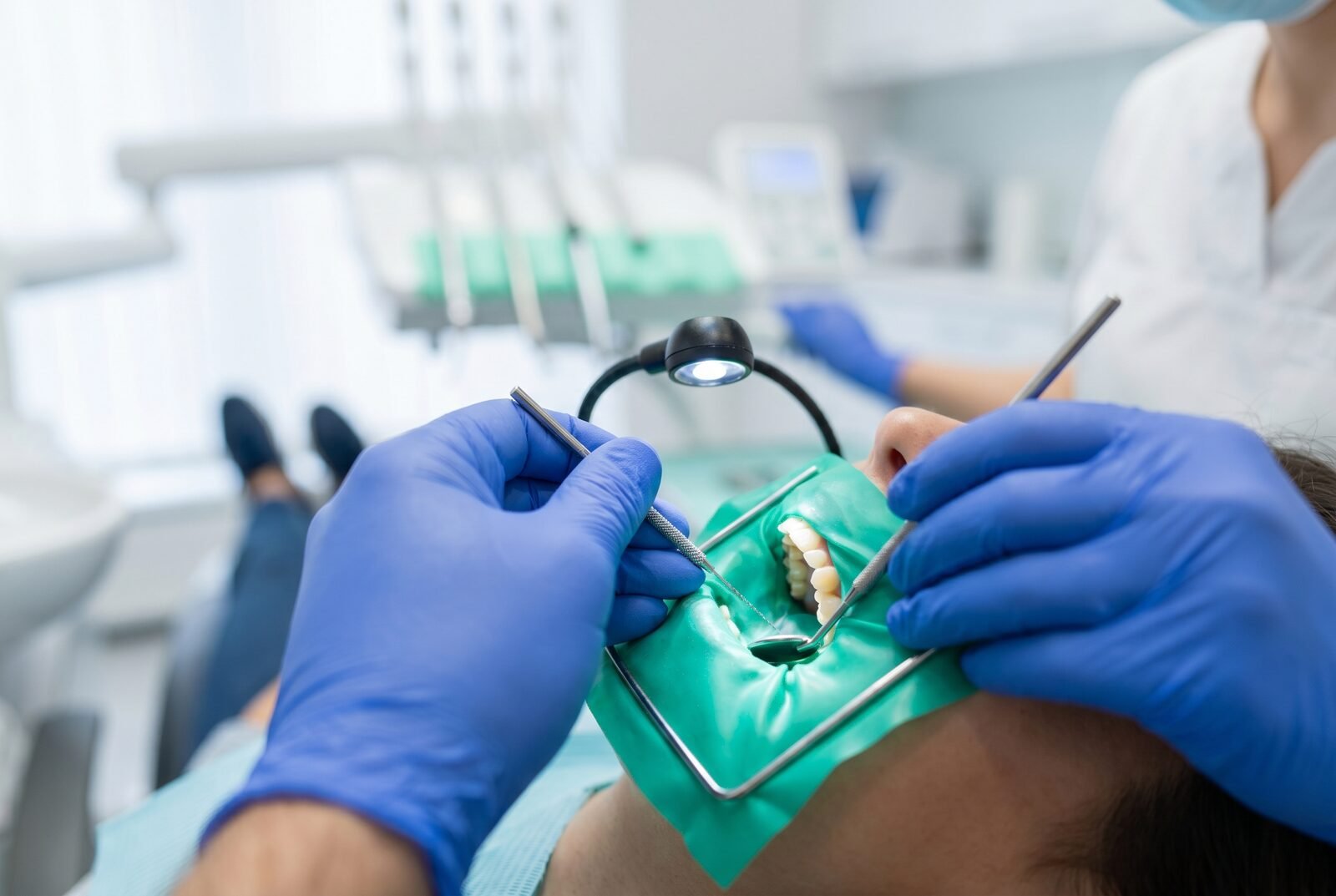
- Isolation of the tooth with a rubber dam, which keeps it clean and dry. It is the standard of care of the European and American endodontic societies.
- Cleaning and shaping of the root canals, with fine instruments that remove the inflamed tissue.
- Obturation, the sealing of the canals with gutta-percha, so they don’t get reinfected.
- Restoration, with a filling and, in many cases, a crown or an inlay/onlay.
The number of root canals varies by tooth. Front teeth usually have one, premolars one or two, while the molars, the back teeth, can have as many as three or four. That’s why a root canal treatment on a molar takes more time.
Do I need a crown afterward?
In most cases yes, especially for back teeth. A tooth that has had a root canal becomes more brittle, and molars take heavy forces when chewing. A crown protects it from fracture and gives it longevity. On front teeth, depending on how much of the tooth remains, a good filling may be enough. It’s a myth that after a root canal treatment the tooth needs nothing else. The final restoration is part of the treatment.
After treatment, what to expect
In the first days after a root canal treatment, mild sensitivity when chewing is normal, especially if there was severe inflammation beforehand. It subsides gradually and is relieved with common painkillers. It’s best to avoid hard chewing on the side of the tooth until the permanent restoration is in place. If the pain is severe, persists or swelling appears, contact the practice. Remember that a temporary filling isn’t the final solution. The tooth needs its permanent restoration, a filling or a crown, within a reasonable time, so it doesn’t get reinfected or break.
How long it lasts, and how successful it is
The treatment is usually completed in one or two visits, depending on the tooth and the inflammation, with each visit lasting roughly 30 to 90 minutes. Success rates are high, typically 85% to 95%, and even higher when the treatment is done by a specialist endodontist with a microscope. A tooth that has been treated properly and is protected with a crown can last many years, often for life.
If the tooth acts up again
Months or years later, a tooth may, less commonly, act up again or become reinfected. That doesn’t automatically mean extraction. We can often save it with retreatment, that is, a second root canal treatment, or with a minor surgical procedure at the root tip, an apicoectomy.
Let’s also clear up two more misconceptions. The tooth doesn’t “die” after a root canal treatment. We remove only the pulp, while the tooth and its roots stay in place and function normally. Nor is root canal treatment linked to other diseases in the body, an old theory that has been rejected by the scientific community.
What makes the difference in a proper treatment
Two root canal treatments on the same tooth can have very different outcomes, depending on how they were done. What counts isn’t speed but precision. Proper endodontic treatment relies on a clear diagnosis, isolating the tooth with a rubber dam, cleaning all the root canals with the help of a microscope, and a clear plan for the final restoration. When all of this is done properly, the tooth has a real chance of lasting for decades.
Our rule: your natural tooth is worth saving. A root canal treatment isn’t the difficult solution, it’s the one that keeps your own tooth instead of an extraction and a future replacement.
Root canal treatment in Ilioupoli
At Dental-i, in Ilioupoli, endodontic treatments are performed by a specialist endodontist, with a microscope and a rubber dam, as international standards of care require. We always start with an accurate diagnosis, to confirm that a root canal treatment is the right solution for your tooth.
Does your tooth hurt or wake you up at night?
Don’t put it off. Book an appointment at Dental-i in Ilioupoli for a checkup and a clear diagnosis, so we can act in time and save the tooth.
Frequently asked questions
No. It is done under local anesthesia and is just as tolerable as a filling. The pain patients remember is the pain before treatment, from the inflammation. Mild sensitivity in the following days passes with simple painkillers.
Usually one or two, depending on the tooth and the inflammation. Molars, which have more root canals, may need a little more time.
Quite often, yes, especially for back teeth, because they become more brittle due to the extent of the damage. For front teeth a good filling may be enough. The dentist decides based on how much of the tooth remains.
Whenever the tooth can be saved, a root canal treatment is preferable. A natural tooth is always better than its replacement.
Less commonly, yes. Even then, we usually save it with retreatment or an apicoectomy, without needing an extraction.
No. We remove only the pulp. The tooth stays in place and functions normally.
As soon as reasonably possible. A temporary filling protects it for a short while, but the tooth needs its permanent restoration, a filling or a crown, so it doesn’t get reinfected or break.
Not necessarily. Antibiotics don’t replace treatment, because they don’t clear out the infected pulp inside the tooth. We use them only in specific cases, for example when the infection has spread. The dentist decides whether they are needed.
Dr Christos Vasilaras
Dentist and co-founder of Dental-i in Ilioupoli. He focuses on cosmetic and restorative dentistry, with an emphasis on results that look natural and stand the test of time.

